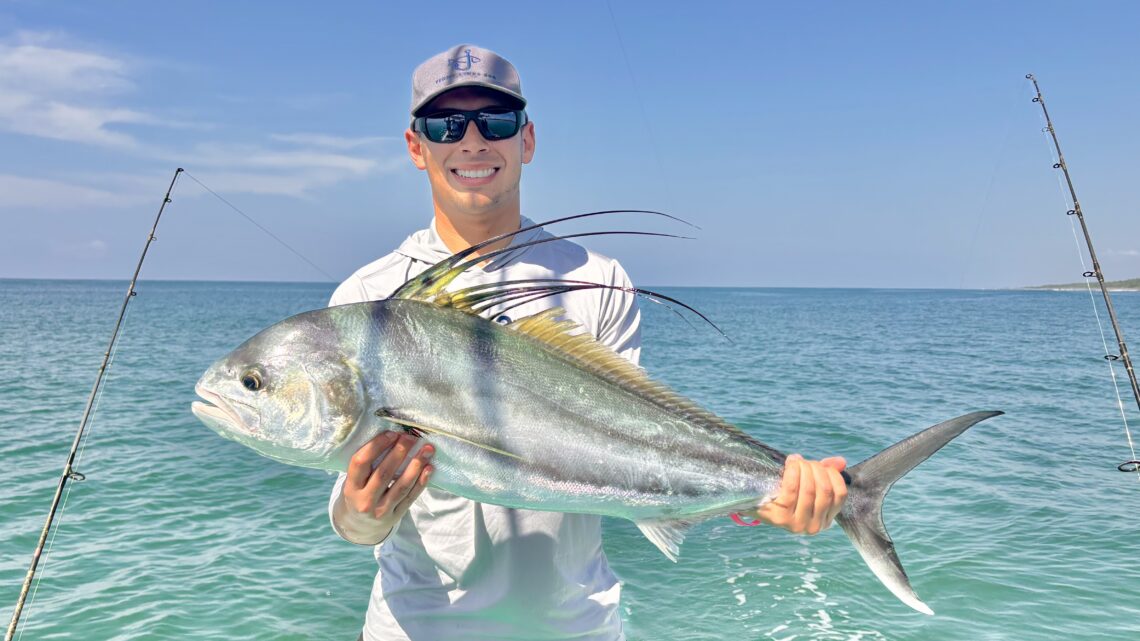
I’ve been blessed to experience some spectacular fish in my lifetime. A giant, prehistoric alligator gar in Texas; a record-sized bass at Lake Havasu; a 40-inch redfish off the Carolina coast. But of all the memorable fish I’ve encountered, my latest catch vaulted to the top of the list.
Our story begins in beautiful Costa Rica, which I recently visited for the first time. I was immediately drawn to the rare opportunity to chase roosterfish—arguably one of the most unique fish on our planet.
Roosters are remarkable for several reasons, most notably the namesake “mohawk” of seven long dorsal fin rays that extend high from atop their heads. Their colors are breathtaking: vibrant teal, splashed with dramatic dark stripes and tinged with hints of iridescent purple and yellow. And to top it off, they are amazing sportfish, known as one of the best pound-for-pound fighters in the sea.
Roosterfish are a one-of-one species, with no living relatives. They’re also rare, found exclusively along a small stretch of coastal Pacific Ocean, between Mexico and Ecuador. Costa Rica falls right in the middle of their range, setting up a prime opportunity to chase my first “Pez Gallo.”
It’s possible to catch a rooster from shore, but your odds are much better in a boat. So, I chartered an inshore guide with buddies Randal, Brian, and Adam, and we embarked from the seaside town of Quepos on a sunny spring morning, filled with hope and anticipation.
Our first task was to catch bait using sibiki rigs. We quickly filled the livewell with sardines, but our captain was adamant that lookdowns—a more full-bodied baitfish—were needed for a successful rooster hunt. Among dozens of sardines, we only had a few lookdowns until our last stop, when Randal and Adam suddenly jigged up loaded sibiki rigs of five apiece! We kept fishing and quickly had 20 lookdowns in the tank. Now, the real mission could begin.
Roosterfish will occasionally chase jigs, spoons, and topwater plugs. But the most effective method is to slow-troll a “bridle-rigged” live bait. Our rods were outfitted with a homemade wire trigger. When a fish took the bait, the line would pop the trigger and free-spool off the reel. Our job was to let the fish take the lookdown for six seconds, and then reel like crazy to ensure a good set with our circle hooks.
The boys decided to let me bat leadoff, and within 20 minutes, our first bite arrived.
“Uno, dos, tres, cuatro, cinco, sies!!” everyone on board chanted in unison.
I grabbed the rod and felt the line flying off the reel. I closed the bail and took 20 cranks as fast as I could, and as the line tightened up, I felt the telltale pressure of a heavy fish, which immediately started peeling drag. We were in!
Over the years, I’ve learned to stay calm in these moments. It’s not easy when the adrenaline kicks in, but staying level decreases the likelihood of mistakes, and it also allows you to enjoy the moment in real-time.
“Tranquillo, amigos, tranquillo!” I mused to my boatmates as the fish powered through the turquoise surf.
After several minutes of drag-burning action, I caught my first glimpse of color 50 feet behind the boat. The body looked roosterfish-shaped, and the smile on our captain’s face confirmed it. Two runs later, we got our first look at its black dorsal comb. True to their reputation, these fish possess amazing stamina, and each time I brought the fish near the boat, it took off on another powerful run.
My most nervous moment came when the guide pulled out a landing net that looked like it belonged on my bass boat back home. How were we going to cram 40 inches of roosterfish into that? But I focused on my job and trusted the captain’s method. Sure enough, he scooped up the rooster on the first try, and there were cheers and high fives all around as we welcomed our first Pez Gallo aboard.
The rooster’s colorful flanks were practically glowing as I held her up for photos and planted a kiss on her forehead. When I released her with a torpedo-style shove back into the sea, I got that rare fishing high that only happens when you’ve experienced something truly special. What an amazing creature!
We worked for our bites that day, but Randal and Brian each did battle with a nice roosterfish of their own, and Adam wrangled a big jack crevalle, another boss-level ocean predator. We laughed, we soaked up the sun, and we swam in 88-degree ocean water with a pod of pilot whales 20 yards away from us. It was an experience I’ll never forget.
Pura Vida, indeed. Tight lines!